“We thought an audit would give us answers. Instead, we got a thick report and more questions.”
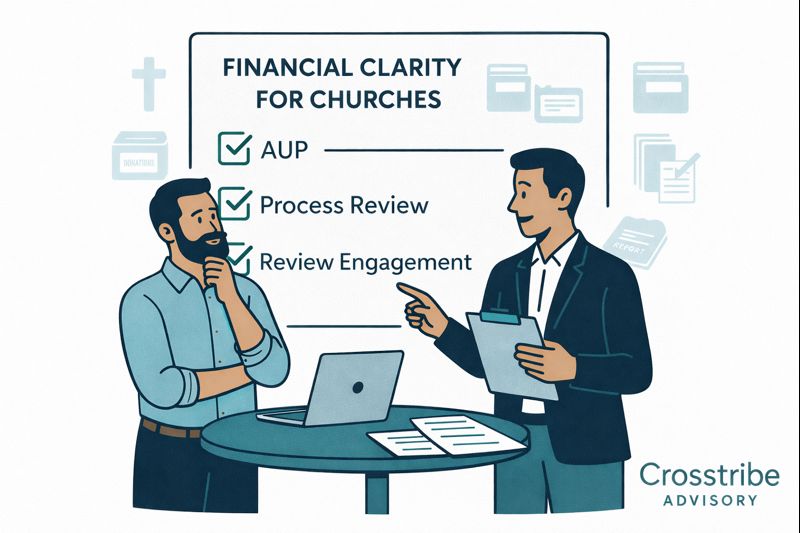
If you’re a pastor, finance chair, or nonprofit leader, you may have had this exact thought after going through a financial audit. You spent time gathering documents. You paid a few thousand dollars. And in the end… you were left wondering:
“Is that it?”
It’s a common issue in the nonprofit world: leaders expect an audit to give them clarity, guidance, or control fixes — but instead receive an abstract assurance opinion. It’s not that the audit was bad. It’s that the audit wasn’t designed to do what you needed.
🙏 Why Church Leaders Ask for an Audit
Many churches and nonprofits ask for a financial audit because:
- The board wants financial accountability
- There’s concern about the current bookkeeper or process
- A new pastor or administrator wants a “clean start”
- They’re trying to build donor trust
- Someone told them they “should probably get one”
But here’s the problem: an audit is not a one-size-fits-all solution.
🧩 What an Audit Actually Does
A financial statement audit is the highest level of assurance a CPA can provide. It includes:
- Detailed testing of transactions and internal controls
- Confirmation of balances with banks or other parties
- A formal opinion on whether your financial statements are fairly presented
But it doesn’t include:
- Telling you how to improve your processes
- Writing up internal control procedures
- Custom testing of specific concerns
- Hands-on coaching or accounting help
And unless the auditor finds something materially wrong, the end result is often a boilerplate report that says:
“In our opinion, the financial statements present fairly, in all material respects…”
To most church leaders, this doesn’t say much.
🤝 So What Are the Better Options?
If your goal is to understand your finances better, improve processes, or verify specific areas of concern, there are other levels of service that may be far more helpful — and less expensive.
Here’s a simple guide:
📌 1. Agreed-Upon Procedures (AUP)
What it is: You and the CPA agree on what to test — like reviewing payroll, cash disbursements, or restricted funds.
What you get: A report of factual findings, no opinions.
Best for: When you have specific concerns, or want to spot-check key areas.
Example: “We’ll test 10 large checks to ensure they were approved and supported.”
💰 Lower cost than an audit, high clarity.
📌 2. Financial Process Review + SOP Manual
What it is: A non-attest consulting service where the CPA walks through your processes and recommends improvements.
What you get: A clear, customized financial procedures manual, plus practical insights on controls, segregation of duties, and efficiency.
Best for: Churches trying to clean up internal operations, train new staff, or improve stewardship.
Example: “We’ll map out your offering process, review how deposits are tracked, and create a step-by-step manual.”
💰 Moderate cost, high operational value.
📌 3. Review Engagement
What it is: A formal CPA engagement providing limited assurance that your financials are not materially misstated.
What you get: A CPA review report — not as deep as an audit, but more than a compilation.
Best for: Churches who want some outside assurance but don’t need an audit.
Example: “The CPA will ask questions and do high-level analytics, but not test individual transactions.”
💰 Middle ground between an audit and an AUP.
📌 4. Full Audit
What it is: A comprehensive CPA examination of your financials and internal controls, following auditing standards.
What you get: A full audit report, possibly with a “management letter” identifying control issues.
Best for: Churches with external requirements — lenders, grantors, or denominational mandates — or those managing millions in revenue or multiple entities.
💰 Most expensive, most formal — but not always the most useful if you don’t need assurance at that level.
✝️ A Better Approach for Faith-Based Organizations
Here’s the bottom line:
Don’t ask for an audit unless you need one. Instead, ask:
“What are we trying to learn or improve?”
Once you define your goals — whether it’s trust, transparency, process improvement, or peace of mind — you and your CPA can choose the right service level.
Many churches benefit from a phased approach:
- Start with an AUP to address specific concerns
- Follow up with a financial process review to strengthen controls
- Add a review or audit later if external parties require it
💬 Final Word
The goal isn’t just to “check a box.” It’s to become better stewards of your resources, build confidence with your board and donors, and set up financial systems that serve your ministry for years to come.
When you choose the right engagement, your CPA becomes more than an auditor — they become a trusted advisor.
✉️ Want help choosing the right level of service for your church or nonprofit?
Let’s talk. I help faith-based organizations find the financial clarity and accountability they’re truly looking for.